
NURSERY TRAY SOLUTIONS · BUYER GUIDE
Nursery & Propagation Tray Types: Cells, Carriers & Pot Fit
Compare propagation trays, pot carriers and growing containers without confusing cell count with growing capacity.
Practical guidance for Australian commercial buying and product development.
Choose the tray’s function before choosing a cell count.
Australian growers use trays for rooting plugs, carrying individual pots, grouping plants and moving material through a nursery. These functions can look similar in a quick product photograph but lead to different dimensions, drainage, support and handling requirements.
Start with the growing and handling system: the crop stage, the pot or plug that must fit, the bench, filling or transplanting equipment, and how staff lift and move a loaded tray. A matching overall outline does not prove that a replacement will work.
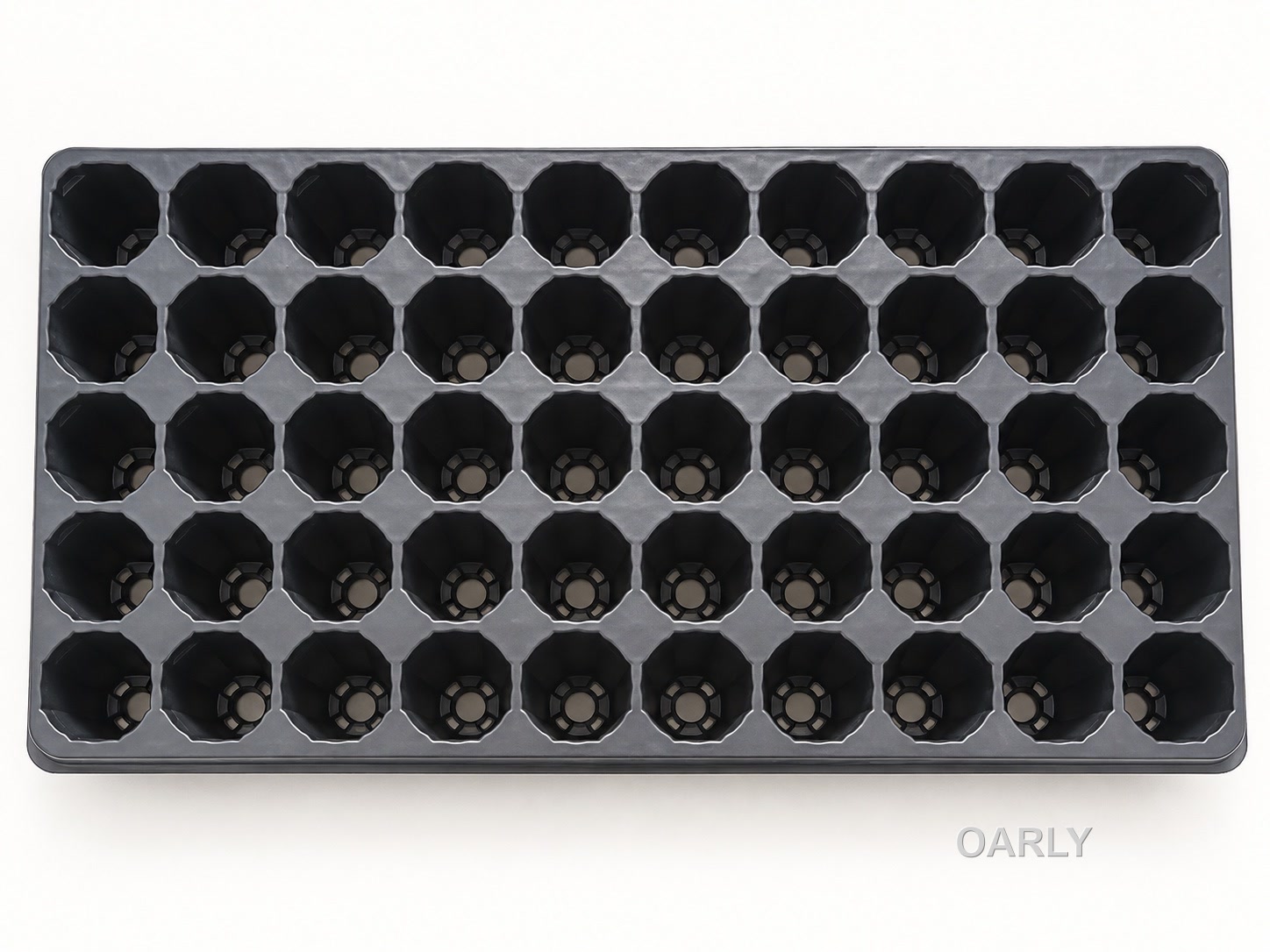
Propagation tray: each cell is a growing cavity.
A plug tray holds growing medium and roots in separate cavities. The important detail is the cell geometry: top opening, depth, taper, nominal volume and drainage. The number of cells describes the layout, not the volume or suitability for every crop.
For example, an Australian-market 50-cell product can have a 533 × 283 × 74 mm footprint and 90 mL nominal cell volume. That is one specific design, not a universal definition of “50-cell”.
Pot carrier: the tray supports separate growing containers.
A carrier must fit the pot’s actual profile and support it during movement. Confirm the rim or base support arrangement, hole spacing, pot retention and the loaded lifting behaviour. A carrier’s hole is not the same specification as a plug tray’s growing cell.
Build a complete tray comparison.
| Feature | What to measure or observe | Why it matters |
|---|---|---|
| Overall footprint and rim | Length, width, corner form and locating features. | Bench layout and equipment compatibility. |
| Cell or pot opening | Shape, opening and pitch. | Root space or correct pot fit. |
| Depth and drainage | Cell depth, bottom opening and support geometry. | Water movement, growing volume and handling. |
| Material and formed weight | Declared polymer, actual tray weight and structure. | A basis for material and handling review. |
| Nesting and loaded support | Stack height, separation and full-tray handling. | Packing efficiency and nursery labour. |
A fit trial should look like real nursery work.
Check the empty tray first, then use the proposed pots or the normal substrate and moisture conditions. Observe lifting, corner support, movement on the relevant equipment, separation from a nested stack and removal of the plant or pot. Record the approved design and the changes needed before ordering at scale.
Oarly can develop plug trays, pot carriers, nursery pots and related formats around the farm’s actual use. Send a current tray or pot, photographs, dimensions and the growing or handling process you need it to suit.
Turn the information into a workable product brief.
Share the current product, your use conditions and what needs to improve. Oarly can help develop the specification, sample pathway and commercial supply proposal.